

Respirator Comms and Hearing Protection
Designed to Work with Respirators and Full PPE
When workers are wearing respirators, Powered Air-Purifying Respirator (PAPR), masks, helmets, eye protection and other forms of PPE, conventional communication systems can become a major problem. Earmuffs, boom microphones and external push-to-talk systems can interfere with the equipment, create pressure points, or require the user to remove or adjust their PPE simply to communicate.
Silynx in-ear communication and hearing protection is designed specifically to overcome these challenges. The compact earbud sits inside the ear rather than around it, while the microphone technology captures the user's voice from inside the ear. This means users can communicate clearly without removing, lifting or compromising their respiratory protection.
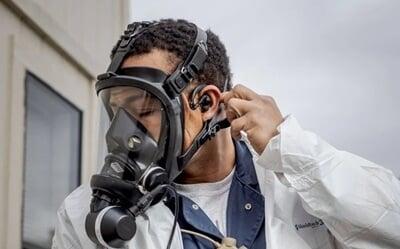
Fits Under Respirators and Other PPE
Silynx in-ear headsets are exceptionally low-profile, allowing them to be worn comfortably underneath a wide range of PPE, including:
- Respirators and half/full-face masks and Powered Air-Purifying Respirator (PAPR)earing protection and other protective equipment
- Safety helmets and hard hats
- Eye protection and safety glasses
- Face shields and visors
- Ballistic and tactical helmets
- Protective hoods and headgear
- High-visibility and specialist protective clothing
Because there is no large earcup or external boom microphone, the headset does not compete for space with other PPE. The result is a cleaner, less obstructed setup that allows workers to wear their required protective equipment correctly while maintaining reliable two-way communications.
Communicate Without Removing Your Respirator
One of the biggest advantages for users working in hazardous environments is the ability to communicate while keeping their respiratory protection in place.
Traditional communication systems often rely on an external microphone positioned in front of the mouth. When a respirator or mask is fitted, this can make microphone positioning difficult and can significantly affect speech intelligibility. In many situations, workers may resort to lifting or removing their mask to communicate — something that can compromise their protection and expose them to the surrounding environment.
With Silynx, the microphone is inside the ear, so the user's voice can be detected without needing access to their mouth.
This allows workers to:
- Communicate while wearing a respirator
- Keep their face and respiratory protection covered
- Maintain hands-free communications
- Avoid repeatedly adjusting or removing PPE
- Communicate with colleagues, supervisors and control rooms
- Connect to radios, phones and other communication devices
The PPE stays in place — communication continues.
Ideal for High-Risk and Noisy Environments
This is particularly valuable for workers operating in environments where respiratory protection and hearing protection are both required. Examples include:
- Fire and emergency response
- Search and rescue
- Industrial and manufacturing sites
- Chemical and hazardous-material environments
- Construction and infrastructure
- Utilities and maintenance
- Confined-space operations
- Mining and quarrying
- Defence and law enforcement
- Marine and offshore operations
In these environments, communication isn't simply about convenience. Being able to receive instructions, warnings and critical information without compromising PPE can be an important part of safe operation.
Better Than Traditional Earmuffs
Traditional earmuffs can provide excellent hearing protection, but they can become difficult to integrate with other PPE. The earcup needs to seal around the ear, which can create conflicts with helmet straps, eyewear, respirators, face shields and other equipment.
Silynx provides hearing protection and communication capabilities in a compact in-ear format.
The result is:
Less bulk. Less interference. More freedom of movement.
In-ear systems are lightweight and allow natural airflow around the ear, helping reduce the heat and moisture build-up that can occur with conventional earmuffs during extended use.
There is also no large earcup pressing against the side of the head, making the system particularly useful when users need to wear helmets, masks or respirators for long periods.
Talking From The Ear™
Silynx's proprietary Talking From The Ear™ technology addresses one of the traditional limitations of in-ear communication systems.
Instead of relying on a conventional microphone positioned in front of the mouth, the system uses an in-ear bone-conducted air microphone to detect subtle internal air movements associated with the user's voice.
Advanced processing then separates the user's speech from surrounding environmental noise, helping deliver clear and intelligible communications even in demanding environments.
Importantly, the technology is designed without applying pressure directly to the bone, helping make the system comfortable for extended periods of continuous wear.
Combined with passive acoustic ear protection, the system provides a unique combination of:
Hearing Protection + Clear Communications + Situational Awareness + PPE Compatibility
Communication That Works With Your PPE — Not Against It
For workers wearing respirators and other restrictive PPE, communication equipment should not force them to compromise their protection or constantly adjust their equipment.
Silynx keeps the communication system inside the ear, leaving the rest of the user's PPE free to do its job.
Whether you're working in a noisy industrial environment, responding to an emergency, operating in a hazardous atmosphere or working in a full PPE configuration, Silynx provides a practical way to hear, communicate and remain protected without taking your gear off.
